
Much of Australia's network was built decades ago, and much of it now needs to be rebuilt - on the same land, connected to the same lines, feeding the same customers, without the luxury of switching anything off for long. That is brownfield substation work, and it is a different discipline from building new.
APD Global's HV substation design practice spans both: greenfield zone substations delivered whole, and the complex brownfield replacements that keep existing networks running while new plant connects. The greenfield jobs make better films. The brownfield jobs are frequently the harder engineering.
Why brownfield is harder than greenfield
On a greenfield site the designer controls everything: the layout, the levels, the construction sequence, the energisation date. On a brownfield site, the existing asset controls most of it. The new works must fit around energised plant, live cable routes, existing earthing systems and secondary wiring that may be older than everyone working on it - and documentation that does not always match what is actually in the ground.
Every design decision carries a second question that greenfield never asks: how do we get from the current state to this one, without dropping supply? The answer is rarely a single step. It is a sequence - and designing the sequence is as much of the job as designing the end state.
Staged cutovers
A brownfield replacement is delivered as a series of intermediate configurations, each of which must be safe, protected and operable in its own right. Load is transferred bay by bay; temporary arrangements carry the network while sections are demolished and rebuilt; new plant is energised alongside old plant that is still doing the work.
Each stage needs its own protection settings, its own operating diagrams and its own reversion plan if something does not go to script. A staging design that only works when everything goes well is not a staging design. The test of the engineering is what happens at each step when the outage is cancelled, the plant fails to prove, or the network cannot spare the second circuit that week.
Protection and SCADA migration
The primary plant is the visible half of a brownfield job. The harder half is usually secondary. Legacy electromechanical and early numerical relays give way to modern IEC 61850 schemes; RTUs and SCADA points migrate to new systems; and through every stage, the protection covering the live network has to remain complete - no gaps, no unintended trips, no blind spots created by a half-migrated scheme.
APD designs protection, automation and SCADA in from the start on this work - relay settings, IEC 61850 engineering, RTU and SCADA cutovers, with lab proving before energisation. Proving cutover logic on the bench, before it is asked to perform on an energised asset, is the difference between a planned migration and an unplanned outage. Where fault levels or network behaviour change with the new configuration, power system studies sit behind the settings work - the fault level and coordination analysis that each staged configuration has to be checked against.
Outage windows
Networks do not hand out outages generously, and the windows they do grant are constrained by season, load and everything else happening on the network that year. Brownfield design is therefore built backwards from the achievable outages: what can physically be done in each window, what must be pre-built and pre-tested beforehand, and what state the site must be left in if the window closes early.
This drives real design decisions - modularising works so they fit discrete windows, pre-commissioning new secondary systems while the old ones still carry the site, and sequencing civil works so that the yard is never dug up in a way that blocks emergency access to live plant.
Working in energised yards
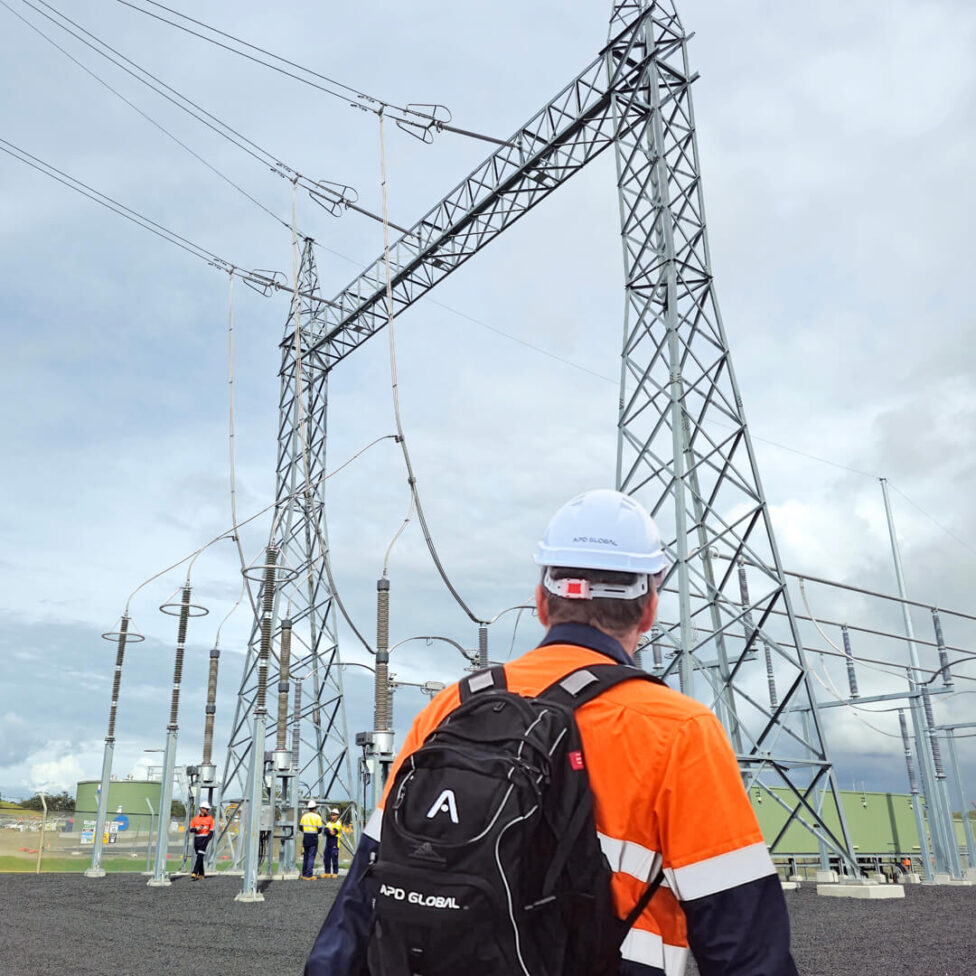
Construction inside an operating substation changes everything about how the design is documented. Safety clearances to live plant constrain crane positions, excavation, scaffolding and even where materials can be laid down. Demarcation between energised and de-energised zones must be explicit on every drawing, for every stage. The earthing system - which is shared between old and new works, and which carries real fault current throughout - has to be assessed and managed through every intermediate configuration, not just the final one.
This is also where design quality pays off most directly. Ambiguity that would be an RFI on a greenfield site is a safety issue on a brownfield one. Documentation has to be written for the crew standing next to energised 132 kV plant, not for the reviewer at a desk.
One bench, whole sequence
Brownfield work punishes fragmented delivery. If the primary layout, the protection migration, the earthing assessment and the staging plan are done by different parties, the gaps appear at exactly the moments when the network is most exposed - mid-cutover, mid-outage, half-migrated. APD Global holds primary, secondary, protection, civil, structural, earthing and SCADA in one house, accredited with Essential Energy, Western Power, Transgrid, ElectraNet, Ausgrid, AusNet and TasNetworks among others - so the staging logic is designed by the same team across every discipline it touches.
Delivered work makes the pattern concrete: at Eraring, a new BESS substation was integrated into the existing 330 kV switchyard with Stage 1 and 2 connection circuits; at Bunning Lake, new secondary systems were delivered into Western Power's existing Sutherland Street substation alongside the new GIS. Rebuilding the grid while it is running is the defining condition of the energy transition - and it is precisely the kind of work a deep in-house substation design bench exists for.