
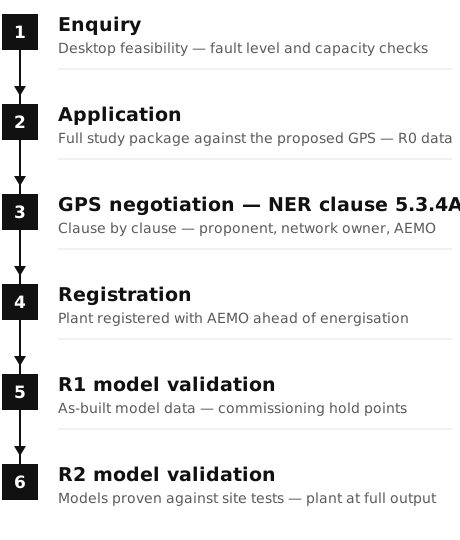
1. Six gates from enquiry to R2
In the National Electricity Market, the process lives in Chapter 5 of the National Electricity Rules. A connection enquiry opens the conversation with the network owner. The connection application follows, carrying the formal study package. The Generator Performance Standards are then negotiated clause by clause under clause 5.3.4A. Registration with AEMO comes next, and the final two gates - R1 and R2 model validation - run through commissioning, where measured plant behaviour has to confirm everything the studies promised.
Western Australia runs its own versions: the South West Interconnected System under the WEM Rules and Western Power's access arrangements, and the North West Interconnected System under Horizon Power's technical rules. The gates carry different names and different data formats, but the engineering underneath them is the same - which is why this guide is organised by study, not by rulebook.
One thing is true on every rulebook: the studies are the critical path. The forms are procedural; the evidence behind them is not. A connection that moves through review in a single round does so because the study package left the reviewers nothing to send back.
2. What studies does a connection need?
A transmission-scale application typically carries all of the following: steady-state load flow, fault level and short-circuit analysis, dynamic and transient stability, a system strength assessment, harmonics and power quality studies, protection coordination, earthing studies at the connection interface, and - for inverter-based plant - EMT studies of the full waveform. Underneath all of them sits the model data, which moves through AEMO's R0, R1 and R2 stages, and over the top sits the GPS compliance assessment that maps every result against the access standards. The rest of this guide takes them one at a time.
The steady-state foundation
3. Steady-state and load flow studies
What they are. The map of the network in normal operation and under N-1 contingencies - voltage at every busbar, thermal loading on every line and transformer, reactive power exchange at the connection point.
Why they are required. The network owner has to know the grid can absorb the plant's output in its current state, and what must be augmented if it cannot. Load flow results also set the opening positions for GPS negotiation: a connection point that is already thermally constrained shapes what access standards are realistic before a single clause is argued.
Where it goes wrong. Treating load flow as a formality. It is the base layer every other study builds on - a load flow run on stale network data quietly corrupts the fault, stability and power quality work stacked on top of it.
4. Fault level and short-circuit studies
What they are. The calculation of the fault current the new plant contributes to every busbar around it - and what that does to switchgear ratings, protection margins and the fault level budget already allocated at the connection point.
Why they are required. If fault current would exceed an existing breaker's rating, something has to change before connection proceeds - and the rules put that evidence on the proponent. Fault level results also feed the protection review and the earthing design, so an error here propagates.
Where it goes wrong. Assuming inverter-based plant is too current-limited to matter. Even a large battery behind current-limiting inverters can push nearby bus fault levels into territory that triggers a protection review - cheap to discover at enquiry, expensive at application.
5. Dynamic and transient stability studies
What they are. The disturbance work: how the plant and the surrounding network ride through faults, voltage dips and frequency events - fault ride-through against the voltage disturbance envelopes in Schedule 5.2 of the NER, large-signal stability under credible and non-credible contingencies, and the recovery behaviour after each.
Why they are required. A plant that trips when the network needs it most makes every disturbance worse. The dynamic studies are AEMO's and the network owner's assurance that the plant holds on, recovers, and helps rather than harms - and they are argued directly against the ride-through clauses of the GPS.
Where it goes wrong. Inverter controls respond faster than synchronous machines and interact with each other in ways phasor-domain models can miss. The wide-area RMS methods for the hardest of these cases - coordinated UFLS and DER shedding under non-credible events - are the subject of CIGRE Paris Session 2026 paper 10487, which APD engineers co-authored with AEMO. The paper →
6. System strength assessment
What it is. A measure of how firmly the network holds the voltage waveform stable near the connection point. Strong grids forgive; weak grids amplify every control imperfection the plant brings.
Why it is required. Low system strength makes inverter-based plant hard to keep stable, so AEMO and the network owners require it assessed - and remediated - before connection. The assessment decides more than a compliance box: it determines whether the plant's controls can even be tuned to work at that location.
Where it goes wrong. Finding the weakness late. At a weak connection point discovered at application rather than enquiry, remediation becomes the project's problem - retuned controls, a revised GPS position, or network remediation costs. Grid-forming inverters change this conversation, because they contribute system strength rather than lean on it; more on that below.
The waveform, the relays and the ground
7. Harmonics and power quality studies
What they are. The assessment of what the plant does to the shape of the voltage - harmonic distortion, voltage fluctuation and flicker - at the connection point and beyond it.
Why they are required. Large inverter-based plant injects harmonics, and the limits at each connection point are enforceable. In Australia, harmonic assessment in transmission and sub-transmission systems follows AS/NZS 61000.3.6, and voltage fluctuation and flicker follow AS/NZS 61000.3.7 - not the UK's G5/5 or P28, which do not apply here. The study is the evidence that the plant stays inside its allocation.
Where it goes wrong. Running the assessment after the design is locked. A poor power quality outcome then means a tighter GPS position, additional filtering plant, or both - costs that were entirely avoidable a design revision earlier.
8. EMT studies
What they are. Electromagnetic transient studies model the full waveform rather than the phasor - the microsecond-scale behaviour of inverter controls, sub-synchronous phenomena and the fast interactions between plants that RMS simulation cannot resolve. They run in PSCAD.
Why they are required. On an inverter-dominated grid, the riskiest behaviour lives below the timescales RMS can see. At low-system-strength connection points, EMT studies are not optional - AEMO and the network owners require them, and most transmission-connected BESS and solar projects now carry both an RMS and an EMT package.
Where it goes wrong. Black-box OEM models that fail model acceptance testing, and RMS and EMT models of the same plant that tell different stories. The two must be benchmarked against each other - and both must match the site tests at R2.
9. Protection coordination studies
What they are. The review of every protection zone that could see the new plant's fault current - relay reach, grading and discrimination, differential boundaries and fault clearance times, confirmed for the network as it will be, not as it was.
Why they are required. A new generator or large load changes fault current magnitudes and directions across its local network. The protection stack must still isolate the right fault, fast, without tripping anything it should not - and the network owner will not energise until that is demonstrated.
Where it goes wrong. Inverter-based resources can present fault signatures that fool conventional distance protection. Desktop settings reviews miss maloperations that EMT simulation - including replay of simulated waveforms into physical relays - catches. That method is published too: CIGRE Paris Session 2026 paper 10392. The paper →
10. The earthing interface
What it is. The assessment of earth potential rise and touch and step voltages at the connection point and the installations around it, when the fault current the new plant contributes finally flows to ground.
Why it is required. Earthing is a safety case, not a design nicety: the grid at the connection point has to keep the people standing on and near it alive through the worst fault the studies predict. On high-voltage transmission connections the currents are large and the neighbouring infrastructure - pipelines, fences, third-party assets - is part of the assessment.
Where it goes wrong. Designing the earthing after the fault level studies have moved on, so the installed grid answers a fault current that no longer exists. The earthing and short-circuit work must share one data set. Earthing design and testing →

11. Model validation: R0, R1 and R2
Every study above is only as good as the models underneath it, which is why AEMO stages the model data three times. R0 arrives with the connection application - preliminary data, usually built on manufacturer models of the proposed inverters or machines. R1 is due at registration, before energisation - updated to the plant as it will actually be built, and the basis on which commissioning hold points are planned. R2 follows commissioning: the models validated against real site test recordings.
The requirements reach past the simulation files. Source models, documentation and releasable user models - versions the operator and network owners can share with other connecting parties - all have to pass model acceptance testing before the studies they feed are accepted.
R2 is where every shortcut taken earlier comes due. A generic inverter model at R0, a controller retuned during procurement and never re-modelled - the gap surfaces at R2, with the plant built, energisation gated on the result and the financiers watching. The cheapest insurance in the entire process is one modelling team held from enquiry to R2, so final validation is a formality instead of a crisis.
12. GPS negotiation: where the engineering becomes commercial
Every technical requirement in Schedule 5.2 of the NER carries two reference points - the automatic access standard, which any plant may connect against without negotiation, and the minimum, below which connection is refused. Nearly every real project settles between them, clause by clause, under clause 5.3.4A.
The clause families translate directly into money. The reactive capability clauses size the reactive plant the project must buy. The ride-through clauses - voltage, frequency, multiple-fault - set what the inverters must survive, and therefore which inverters qualify. The active power and frequency control clauses define the control systems and their tuning. The voltage control clauses determine the plant's behaviour as a network citizen, and the monitoring and protection clauses fix what must be measured, recorded and proven for the life of the asset.
Pitch a clause too close to the automatic standard and the project buys plant it never needed; too close to the minimum and it invites rejection, or remediation later at commissioning prices. Each position is argued on study evidence - which is why the GPS strategy should be settled when the studies start, not after the application is lodged. Where that lands when it is done well: AMPYR Australia's 270 MW Northern Battery received its 5.3.4 letter in October 2026, with APD Global among the project partners.
The proof, published and energised
Summerfield BESS 1 & 2
Engineering the connection behind large-scale storage - a new 275 kV substation and some 17 km of transmission infrastructure into ElectraNet's network.
The story →The UFLS paper
Paper 10487, co-authored with AEMO - dynamic modelling of coordinated UFLS and DER shedding across a 3,500-bus wide-area model of the NEM.
The paper →The GFM BESS paper
Paper 11251 - compliance and model validation of a grid-forming battery replacing synchronous generation on Australia's northern grid. Real integration, not vendor promise.
The paper →13. The same studies, different rulebooks: SWIS and NWIS
Everything above holds in Western Australia - the physics does not read the rules. What changes is the framework: the SWIS runs under the WEM Rules, with Western Power operating the network and AEMO administering the market from Perth; the NWIS and the wider Pilbara networks run their own technical rules under Horizon Power and the Pilbara ISOCO. The clauses, data formats, approval gates and cost frameworks all differ, and east-coast assumptions applied to a WA application reliably produce a first-round rejection. The SWIS connection guide walks Western Power's transmission process gate by gate, and the Grid Connection Navigator covers every Australian network, state by state.
Frequently asked questions
What studies are needed for grid connection in Australia?
A transmission-scale connection application typically carries steady-state load flow, fault level and short-circuit analysis, dynamic and transient stability, a system strength assessment, harmonics and power quality studies, protection coordination and earthing studies, EMT studies for inverter-based plant, and a clause-by-clause GPS compliance assessment - all built on model data that moves through AEMO's R0, R1 and R2 stages.
What is GPS compliance?
Demonstrated conformance with the Generator Performance Standards negotiated for the plant under NER clause 5.3.4A. It is proven by studies before connection, confirmed by site tests and validated models through R1 and R2, and then maintained for the operating life of the asset.
What happens at R2 model validation?
During commissioning, the plant's responses to staged tests are recorded on site, the dynamic models are re-run against those recordings, and any mismatch between model and measurement is resolved before the final R2 data set is submitted. R2 is the proof that the plant behaves on the grid the way the studies said it would.
When are EMT studies required?
Whenever inverter-based plant connects where RMS models cannot resolve the risk - low system strength connection points, potential control interactions between nearby inverters, and sub-synchronous phenomena. EMT studies run in PSCAD on the full waveform, and most transmission-connected BESS and solar projects in Australia now require them alongside the RMS package.
Who carries out grid connection studies in Australia?
Specialist power systems consultancies working in the tools the reviewers use - PSS®E, PSCAD and DIgSILENT PowerFactory - with validated models behind every submission. APD Global has delivered 15 GW+ of grid connection studies across the NEM, WEM, SWIS and NWIS, and publishes its methods through CIGRE, including a Paris Session 2026 paper co-authored with AEMO.
Talk to the team that connects them
APD Global delivers grid connection engineering across Australia - connection studies, GPS negotiation, registration and R1/R2 validation through commissioning, with the power system studies, substation design and line works in one house. Connecting a battery? The study path is heavier, and it has its own page.