
Generator Performance Standards (GPS) are the negotiated technical requirements a generating system must meet to connect and operate in the National Electricity Market - set clause by clause against Schedule 5.2 of the National Electricity Rules, agreed between the proponent, the network service provider and AEMO, and binding for the life of the plant. Western Australia's SWIS runs an equivalent GPS framework under the WEM Rules. Everything below is how that standard gets negotiated, proven and kept.
1. What a GPS covers: the S5.2.5 clause families
What are the Australian standards for generators?
For grid connection, the National Electricity Rules - the S5.2.5 clauses of Schedule 5.2 set the performance requirements every registered generating system negotiates as its GPS. Western Australia's WEM Rules carry an equivalent framework for the SWIS. The machines themselves are built to their own Australian and IEC product standards; the GPS governs how the connected plant behaves on the network. AEMO →
A GPS is not one standard but a stack of them - one negotiated position per clause of Schedule 5.2, each with its own engineering content. The families: reactive power capability (S5.2.5.1), which sizes the reactive plant the project must buy; quality of electricity generated (S5.2.5.2) - harmonics, voltage fluctuation, unbalance; the ride-through family - response to frequency disturbances (S5.2.5.3), voltage disturbances (S5.2.5.4) and multiple contingency events (S5.2.5.5) - which decides what the plant must survive without tripping; the protection clauses (S5.2.5.8–10), fixing how the plant protects itself and the system from its own failures; the control family - frequency control (S5.2.5.11), impact on network capability (S5.2.5.12), voltage and reactive power control (S5.2.5.13) and active power control (S5.2.5.14) - which defines the control systems, their tuning and their response times; and the monitoring and control clauses of S5.2.6, fixing what must be measured, recorded and remotely controllable for the life of the asset.
System strength sits beside the GPS rather than inside it: assessed for every new inverter-based connection under the NER's system strength framework, and resolved either by network remediation the project pays for or by what the plant itself brings - which is where grid-forming inverters have changed the conversation. The studies that put numbers behind every one of these clauses are their own discipline, walked study by study in the grid connection guide; this page stays on the standard itself.
Grid connection engineering
Connection studies, GPS negotiation, registration and R1/R2 validation through commissioning - 15 GW+ delivered across the NEM, WEM, SWIS and NWIS.
The grid connection service →2. Automatic, negotiated, minimum: the access-standard spectrum
Every technical clause in Schedule 5.2 carries two published reference points. The automatic access standard is the level at which a plant may connect without negotiation - meet it and that clause is settled. The minimum access standard is the floor below which the connection must be refused. Between them sits the space where nearly every real project lands: the negotiated access standards, agreed clause by clause under NER clause 5.3.4A, on study evidence.
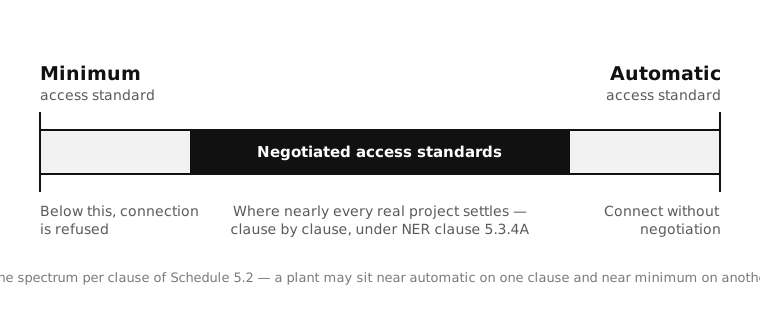
The spectrum is per clause, not per plant - and that is what makes the GPS a design document rather than a compliance form. Each negotiated position buys or saves real equipment: a tighter reactive capability position means more reactive plant; a harder ride-through position narrows the inverter shortlist; a more demanding control position reaches into firmware and tuning. Pitch a clause higher than the project needs and it buys plant it never uses; pitch it at the floor and it invites rejection now or remediation later, at commissioning prices. The negotiating position on every clause should be set when the studies start - because the studies are the evidence the position stands on.
3. The ride-through clauses: the envelope the plant must survive
The ride-through family is where the GPS bites hardest on equipment selection. S5.2.5.4 and S5.2.5.5 define the voltage disturbances the plant must ride through - single faults, and then the harder case of multiple disturbances in succession - while S5.2.5.3 does the same for frequency excursions. Together they draw an envelope around the connection point: a region of voltage and time inside which the plant must remain connected, keep operating and help the system recover, no matter what the disturbance looks like.
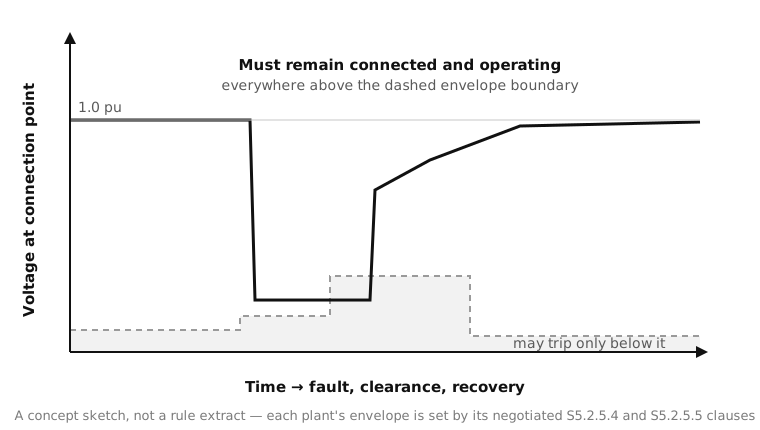
The envelope is proven twice: in simulation, where the dynamic studies drive the models through the disturbance cases and the results are argued clause against clause - and then at commissioning, where staged tests confirm the plant the studies described is the plant that got built. For inverter-based plant the envelope reaches into the machine itself: ride-through is control firmware behaviour, not iron, and a controller retuned during procurement without the models following it is how an R2 campaign turns into a crisis.
4. Where the GPS sits: the 5.3.4A negotiation
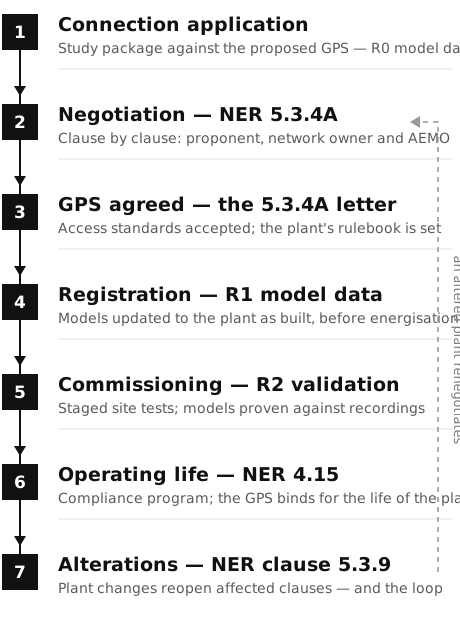
In the NEM's Chapter 5 process, the GPS is the centre of gravity of the connection application. The enquiry establishes feasibility; the application arrives carrying the proposed performance standards and the study package behind them; and then the negotiation runs - proponent, network service provider and AEMO, clause by clause, with AEMO advising on the matters the rules assign to it. The studies are the currency of that conversation: a clause position without evidence behind it is an opinion, and reviewers do not accept opinions.
What is a 5.3.4A letter?
The written confirmation that the access standards negotiated for a connection have been settled under NER clause 5.3.4A - the milestone that locks the plant's Generator Performance Standards and clears the application to proceed towards a connection agreement and registration. AMPYR Australia's 270 MW Northern Battery reached it in October 2026, with APD Global among the project partners.
Once settled, the GPS is registered against the plant and becomes the reference every later gate measures against: the commissioning program is built around demonstrating it, the R2 validation proves the models that justified it, and the compliance regime holds the plant to it for life. That permanence is the part proponents underestimate - the GPS outlives the EPC contractor, the asset manager and usually the owner who negotiated it.
5. R0, R1, R2 - and the DMAT gate underneath
What are R0, R1 and R2?
AEMO's three model data stages. R0 arrives with the connection application - preliminary models of the proposed plant. R1 is due at registration, before energisation, updated to the plant as it will actually be built. R2 follows commissioning: the same models validated against recorded site tests, proving the plant behaves the way the studies said it would.
What is DMAT?
The Dynamic Model Acceptance Test - AEMO's screening suite that a dynamic plant model must pass before it is used in connection studies. DMAT checks the model is numerically stable, initialises cleanly, responds plausibly to standard disturbances and matches its documentation. A model that fails DMAT stalls the application before any GPS clause is argued.
The model lifecycle is where GPS positions are won and lost. Every clause is argued on simulation evidence, so the models carry the whole case - RMS and EMT versions of the same plant that must tell the same story, benchmarked against each other and eventually against the site. The discipline that keeps R2 a formality rather than a crisis is continuity: one modelling team held from application to validation, so the models evolve with the plant instead of being rebuilt to explain it afterwards. APD publishes this discipline rather than just practising it - including the compliance and model validation of a grid-forming battery replacing synchronous generation on Australia's northern grid, CIGRE Paris Session 2026 paper 11251. The paper →
6. After energisation: compliance, and the 5.3.9 loop
What happens if a generator breaches its GPS?
The generator must notify AEMO, investigate and rectify - NER clause 4.15 places the compliance obligation, and the burden of a compliance program, on the generator. Sustained non-compliance invites AER enforcement, operating constraints while the problem stands and, at the extreme, disconnection. The GPS does not expire at commissioning; it binds for the plant's operating life.
Compliance in practice is a standing program, not an annual declaration: monitoring that would reveal a departure from the registered standards, records that prove settings have not drifted, and model currency - because a plant whose controls no longer match its R2 models is non-compliant in the way that matters most, invisibly. Disturbance recordings are the audit trail; when the system has a bad day, AEMO compares what the plant did against what its GPS said it would do.
And plants change. Clause 5.3.9 of the NER governs alterations to a connected generating system - repowering, inverter replacement, control firmware upgrades, capacity changes - and an alteration that could affect performance reopens the affected GPS clauses: fresh studies, updated models, renegotiated positions where the change demands them. The lifecycle diagram above is honest about this - the loop from operating life back into negotiation is one most assets travel at least once, and battery augmentations are making it routine.
7. GPS in due diligence and financing
The GPS is the asset's technical constitution, and lenders read it that way. In financing and acquisition due diligence, the technical advisor's questions are predictable: where does each clause sit on the spectrum, and is any position marginal; do the R2-validated models match the plant as it stands today; is the compliance program real - monitoring, records, disturbance analysis - or a folder; and has anything been altered since energisation without the 5.3.9 process that should have followed it. A marginal ride-through position or a stale model set is priced as risk, because fixing either after financial close is expensive in exactly the ways the data room was supposed to reveal.
The same logic runs forward from the other end: a GPS negotiated with the plant's financing in mind - defensible positions, clean evidence, models that will survive validation - is cheaper than one patched up for a data room later. The time to think about the lender's engineer is before the first study is run.
8. The west: GPS under the WEM Rules
Western Australia's South West Interconnected System is not part of the NEM, and its rulebook is its own - but the concept crossed the Nullarbor. The WEM Rules carry a Generator Performance Standards framework for SWIS connections with the same architecture: tiered access standards, negotiated positions, registered obligations and a compliance regime, administered through AEMO with Western Power as the network operator. The clause references, data requirements and process gates differ enough that east-coast assumptions reliably fail first review - the SWIS connection guide walks Western Power's process gate by gate.
The discipline holds at both ends of the asset's age range, too. APD's team took a fifty-year-old alumina refinery's generation on the SWIS through site testing, dynamic model development and full GPS registration with AEMO - legacy machines, layered upgrades and all. That story →
The standard, held on real plant
From a fifty-year-old refinery to a grid-forming battery.
A fifty-year-old plant, fully compliant
Site testing, dynamic models and full GPS registration with AEMO for an alumina refinery's legacy generation on Western Power's network.
The story →Northern Battery - the 5.3.4 letter
AMPYR Australia's 270 MW battery on the former Northern Power Station site reached its connection milestone with APD Global among the project partners.
The studies behind it →The GFM BESS paper
Paper 11251 - compliance and model validation of a grid-forming battery replacing synchronous generation on Australia's northern grid.
The paper →Frequently asked questions
Do batteries need a GPS?
Yes. A grid-scale battery negotiates Generator Performance Standards like any other registered plant - with the added complication that its clauses are assessed in both directions, charging and discharging, and that the inverters' ride-through and control behaviour carries the case. Most transmission-connected BESS also carry EMT studies alongside the RMS package. The battery-specific path has its own page.
What is AEMO Australia?
The Australian Energy Market Operator - the body that operates the National Electricity Market across the eastern states, administers the Wholesale Electricity Market in Western Australia and plans the power system. For a connecting generator, AEMO is the counterparty that assesses models, advises on negotiated access standards and registers the plant.
Is a generator rated in kW or kVA?
Both, deliberately. kVA is apparent power - the full electrical capacity of the machine; kW is the real power it delivers, the two related by power factor. Standby gensets are typically quoted in kVA; grid-scale plant is registered in megawatts, with its reactive capability negotiated separately as a GPS clause rather than read off a nameplate.
What is the 80% rule for generators?
A sizing rule of thumb from the standby-generator world: run a genset at no more than about 80 per cent of rated capacity in continuous service, keeping headroom for starting loads and avoiding sustained full-load wear. Good practice for diesel sets - and entirely separate from the Generator Performance Standards grid-connected plant negotiates under the NER.
What is grid-connected renewable energy?
Renewable generation - wind, solar, hydro and the batteries alongside them - connected to a public electricity network and operating synchronised with it, exporting through a metered connection point. In Australia, transmission-scale renewable plant connects under Chapter 5 of the National Electricity Rules, with a negotiated GPS defining exactly how it must behave on the grid.
Talk to the team that negotiates them
APD Global delivers grid connection engineering across Australia - GPS negotiation, the power system studies every clause position stands on, registration and R1/R2 validation through commissioning. The studies themselves, gate by gate, live in the grid connection guide.