
The voltage where the engineering stops scaling gently
Most transmission work in Australia is designed at 132 to 330 kV, and the methods scale comfortably from one level to the next. At 500 kV - the backbone voltage of Australia's new transmission build - several things change character at once. Clearances grow to the point where they drive the geometry of everything: tower head width, insulator string length, swing envelopes under wind, crossing heights and the footprint of every yard the line terminates in. Insulation coordination becomes a study in its own right, where switching overvoltages - not just lightning - can govern the design. And structures reach the scale where full-scale testing is the only honest proof.
APD Global works on both sides of that build: transmission line design including 500 kV tower families, and HV substation design up to 500 kV - with the power system studies run alongside the physical design, so the electrical envelope and the structural geometry are settled as one problem.
500 kV transmission line design - tested at full scale
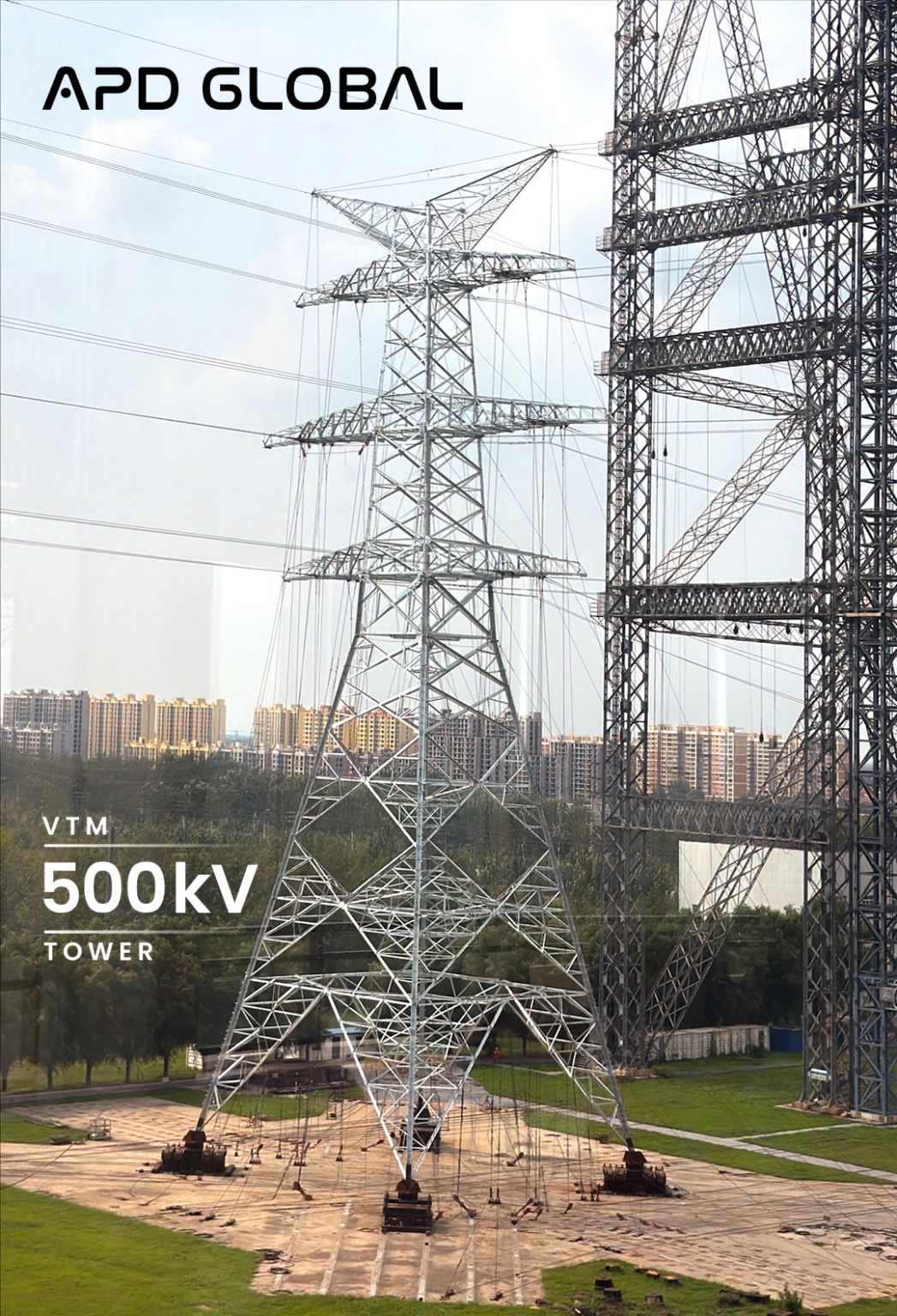
On HumeLink West - the alpine section of Transgrid's 500 kV link between Wagga Wagga and Maragle, detail-designed by APD with UGL - the VTM strain towers stand 74.2 metres tall and weigh 150 tonnes, engineered for ice and wind loading conditions that most of the Australian network never sees. APD took the VTM tower from first outline through detailing, proto-assembly inspection and shop-drawing preparation - and it passed full-scale load testing at 110% under the project test programme. On HumeLink East, APD delivered the tender-stage design with Acciona. The VTM proof →
On CopperString - the Queensland line intended to connect the North-West Power System near Mount Isa and Cloncurry to the National Electricity Market at Woodstock - APD is designing two 500 kV tower families: the suspension tower D5S2BI and the light tension tower D5T15BI. The defining problem there is distance and repetition: structures replicated along a very long corridor, where every kilogram of steel saved per tower multiplies across the line. Same voltage, same team, opposite optimisation targets. CopperString →
Selected 500 kV projects
Three 500 kV problems, one team.
HumeLink East and West
Tender-stage design with Acciona. Detail design with UGL - alpine VTM strain towers to 74.2 m and 150 tonnes, proven at 110% in full-scale load testing.
CopperString tower design
500 kV suspension tower D5S2BI and light tension tower D5T15BI on the line that will join Mount Isa to the National Electricity Market.
Central West Orana REZ
Tender design for EnergyCo's first large-scale REZ - studies, more than 200 km of 500 kV and 330 kV line, and 500 kV and 330 kV substation yards unlocking 3 GW.
500 kV substations - where the backbone lands
Every 500 kV line ends in a yard, and the yard inherits the voltage's problems. Clearances that were managed in the air along the easement have to be resolved inside a fenced site - bus heights, phase spacings, incoming gantries sized for backbone-class conductor tensions, and insulation coordination carried through from the line into the station plant. Earthing must handle the fault levels of a backbone connection point, and the protection and secondary systems must meet transmission-network operator requirements.
APD Global's substation practice covers this end of the problem to 500 kV - from zone substations up to the terminal stations of REZ transmission, with the 500 kV and 330 kV yard designs on Central West Orana as delivered tender-stage evidence. Earthing sits with the same team - CDEGS modelling, EPR, LFI and EMF assessments, lightning protection and pipeline assessments, backed by site testing that matches the model. HV substation design →
The studies behind the steel
At 500 kV, insulation coordination is a study in its own right rather than a table lookup. Switching surges, lightning performance, pollution performance and altitude effects have to be engineered together - one of the study disciplines APD's power systems team runs alongside the physical design. The wider studies capability covers load flow, fault level, stability, system strength, harmonics and model validation, in PSCAD, PSS®E and DIgSILENT PowerFactory. Power system studies →
The REZ context
The reason 500 kV design capability matters right now is the Renewable Energy Zone build-out. On Central West Orana, APD was engaged by ACEREZ to perform the tender design - studies, lines and substations as one technical solution capable of unlocking 3 GW - and ACEREZ was awarded the project on that tender. REZ work makes the backbone voltage a system design problem: the studies determine what the network needs, the line design carries it, and the substations connect it. REZ engineering →
500 kV FAQ
What changes in transmission design at 500 kV?
Clearances, insulation coordination and structure scale all step up together. Clearances drive the geometry of everything, and switching overvoltages - not just lightning - can govern the insulation design. The full insight →
Who designs 500 kV transmission towers in Australia?
Specialist firms on the transmission network owners' panels. APD Global holds panel appointments with Transgrid, Western Power and Transpower, and is designing 500 kV tower families on HumeLink and CopperString.
Why are 500 kV towers load-tested at full scale?
Because at this scale, analysis alone is not the end of the argument. Full-scale load testing is the physical proof the structure survives its design events - the HumeLink West VTM tower proved at 110%.
What does 500 kV substation design involve?
Bus heights, phase spacings, gantries sized for backbone-class tensions, insulation coordination carried into the station plant, earthing for backbone-level fault levels and protection meeting network operator requirements - all designed together.
Why is 500 kV design in demand right now?
Australia is building more backbone-voltage infrastructure than it has in decades - HumeLink, CopperString and the REZ programs. The firms doing the engineering are the ones with tower design, studies and substation capability under one roof.
Related
Transmission line design
Overhead line and cable design, 330/500 kV tower design and stringing systems.
Explore →HV substation design
AIS and GIS, primary, secondary, protection and earthing - up to 500 kV.
Explore →Designing at 500 kV - the insight
What changes at the backbone voltage - clearances, insulation coordination and full-scale proof.
Explore →