
Generator performance and grid connection studies are the power system analyses - load flow, fault level, stability, power quality and EMT - that prove a generator, battery or load meets the Generator Performance Standards negotiated with AEMO and the network service provider under the National Electricity Rules. In the NEM that negotiation runs clause by clause under NER clause 5.3.4A; in Western Australia the WEM Rules carry the equivalent framework for the SWIS. Whether the network service provider is Transgrid, ElectraNet or Western Power, the studies are one discipline wearing two names - and this page is the map of both.
1. Two names, one discipline
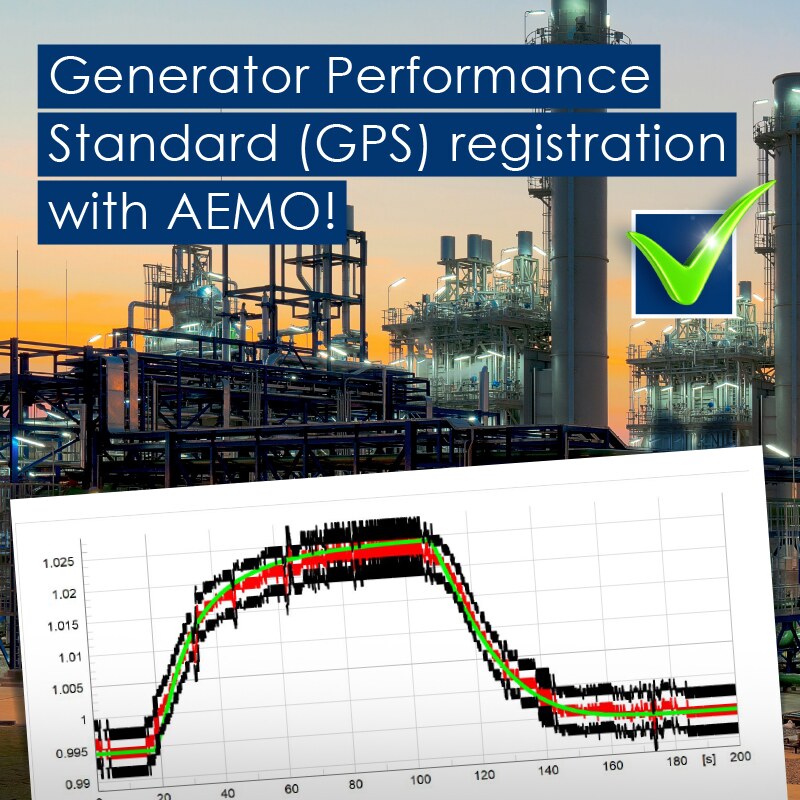
Generator performance studies are the simulations run to set and defend the plant's Generator Performance Standards - the negotiated technical requirements of Schedule 5.2 of the NER, agreed between the proponent, the network service provider and AEMO and binding for the life of the plant. Every GPS clause position is argued on simulation evidence: the reactive capability the plant offers, the disturbances it rides through, the way its controls respond. A clause position without a study behind it is an opinion, and reviewers do not accept opinions.
Grid connection studies are the wider technical package a connection application carries - everything the generator performance work proves, plus the network-facing assessments the owner of the wires needs before it will connect anything: the fault current the plant adds to every busbar around it, the protection zones that fault current reaches, the earthing interface that keeps people alive when it finally flows to ground. Each of those studies is walked one at a time in the grid connection process guide.
The distinction matters less than the overlap. The two families run on the same network data and the same plant models, feed each other's results, and converge on one submission. Split them across two consultancies and the seams show at review; run them as one package and the application moves. That is how APD delivers them - one team, one model set, enquiry to R2.
Grid connection engineering
Connection studies, GPS negotiation, registration and R1/R2 validation through commissioning - 15 GW+ delivered across the NEM, WEM, SWIS and NWIS.
The grid connection service →2. How the two families interlock: the 5.3.4A process
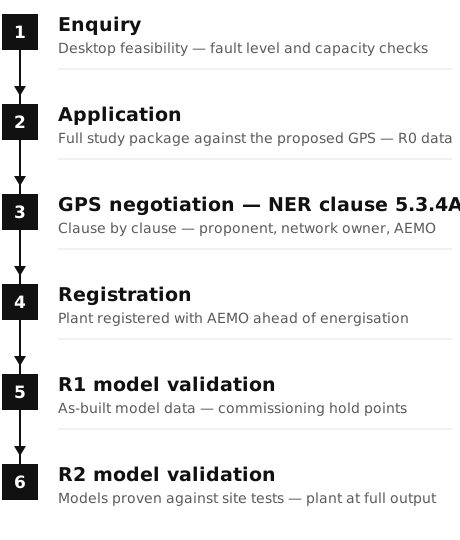
In the NEM, the connection process lives in Chapter 5 of the National Electricity Rules, and the studies are its critical path at every gate. The connection enquiry opens the conversation with the network service provider and scopes what the studies will have to prove. The connection application arrives carrying the full study package and the R0 model data - the grid connection studies in their broadest sense. Then the clause 5.3.4A negotiation runs, and the package changes character: each study is now evidence for a specific GPS clause position, argued between proponent, NSP and AEMO until the access standards are settled and confirmed in writing. Registration follows with R1 models updated to the plant as built, and commissioning closes the loop at R2, where recorded site tests must validate the models every clause position stood on.
Read that sequence again and the interlock is obvious: the grid connection studies are the generator performance case, staged. The same load flow that tells the NSP its lines can carry the output sets the opening position on reactive capability. The same stability runs that satisfy AEMO the system holds together are the ride-through evidence for S5.2.5.4 and S5.2.5.5. Nothing is run twice - unless the two families were procured apart, in which case plenty is.
3. Core types of grid connection studies
The core types of grid connection studies are power flow (load flow) analysis, fault level (short circuit) assessment, protection coordination, dynamic (RMS) stability, EMT (PSCAD) studies, harmonics and power quality, earthing, and model validation (R0–R2). In plain English, one sentence each:
- Power flow (load flow) analysis: Simulates steady-state voltages, thermal loading and reactive power exchange to confirm the network can absorb the plant's output at the connection point under normal and N-1 conditions.
- Fault level (short circuit) assessment: Calculates the fault current the plant adds at every nearby busbar, confirming switchgear ratings and the connection point's fault level limits are never exceeded.
- Protection coordination study: Verifies every relay that sees the plant's fault contribution still isolates the right fault, fast, without tripping healthy plant - evidencing the NER's protection clauses (S5.2.5.8–10).
- Dynamic (RMS) stability study: Simulates how the plant rides through faults, voltage dips and frequency disturbances - and recovers - proving the GPS ride-through clauses (S5.2.5.3–5) under credible contingencies.
- EMT (PSCAD) study: Models inverter behaviour at full waveform level to expose control interactions and sub-synchronous risks that RMS simulation cannot see, essential at low-system-strength connection points.
- Harmonics and power quality study: Assesses harmonic distortion, voltage fluctuation and flicker against the emission allocation set for the connection point under AS/NZS 61000, proving GPS clause S5.2.5.2 (quality of electricity).
- Earthing (EPR) study: Confirms earth potential rise and touch and step voltages at the connection point stay survivable through the worst fault the network can deliver - the safety case beside the GPS.
- Model validation (R0–R2): Proves the simulation models behind every other study match the plant as built, from application data (R0) through registration (R1) to commissioning tests (R2).
4. The study-to-clause map
Every core study type maps to the GPS clauses it proves. This is the working version of that map for a transmission-scale connection - the deep dive on each study lives in the grid connection process guide, and the deep dive on each clause family in the generator performance standards guide.
| Study | What it proves | GPS clauses it evidences |
|---|---|---|
| Load flow | The network can absorb the plant's output - voltages, thermal loading and reactive exchange under normal and N-1 conditions. | S5.2.5.1 reactive capability · S5.2.5.12 impact on network capability |
| Fault level | The fault current the plant contributes stays within switchgear ratings and the fault level budget at the connection point. | S5.2.5.8–10 protection clauses · plant and network ratings |
| Stability (RMS) | The plant rides through faults, voltage dips and frequency events - and recovers - under credible and non-credible contingencies. | S5.2.5.3 frequency · S5.2.5.4 voltage · S5.2.5.5 multiple disturbances |
| Control studies | Voltage, frequency and active power control systems are tuned, stable and respond within the negotiated times. | S5.2.5.11 frequency control · S5.2.5.13 voltage/reactive control · S5.2.5.14 active power control |
| Power quality | Harmonic distortion, voltage fluctuation and flicker stay inside the connection point's allocation, to AS/NZS 61000.3.6 and 61000.3.7. | S5.2.5.2 quality of electricity generated |
| EMT (PSCAD) | Waveform-level inverter behaviour - control interactions, sub-synchronous phenomena - holds up where system strength is low and RMS models cannot see the risk. | Ride-through and control clauses at weak connection points · system strength framework · DMAT model acceptance |
| Protection | Every relay that sees the plant's fault current still isolates the right fault, fast, without tripping what it should not. | S5.2.5.8–10 protection and fault clearance |
| Earthing | Earth potential rise and touch and step voltages stay survivable through the worst fault the studies predict. | Connection agreement safety case - beside the GPS rather than inside it |
| Model validation | R0, R1 and R2 - the models behind every row above match the plant as built, proven against recorded site tests. | All of the above · NER 4.15 compliance for the operating life |
System strength deserves its own line of fine print: it is assessed for every new inverter-based connection under the NER's system strength framework and sits beside the GPS rather than inside it - but it decides whether the EMT row above is a formality or the hardest work in the package. Grid-forming inverters are changing that conversation, because they contribute system strength rather than lean on it.
5. Who needs them
Wind, solar, hydro, thermal
Every registered generating system in the NEM negotiates a GPS, and every GPS stands on studies. Technology changes the emphasis - inverter-based plant carries EMT, synchronous plant argues its machine data - but no technology skips the package.
Grid connection services →BESS and hybrid plants
Batteries run the same studies in both directions - every clause assessed charging and discharging - and most transmission-connected BESS now carry an EMT package alongside the RMS work. The battery-specific path has its own page.
BESS grid connection →Industrial loads and data centres
Connection studies are not only for exporters. Mines, hydrogen electrolysers and data centres draw enough, fast enough, that the network owners require load flow, fault, power quality and stability evidence before connection - and performance requirements follow.
Connecting data centres →6. NEM and WEM: same studies, different rulebooks
Everything above holds in Western Australia, because the physics does not read the rules. What changes is the framework. The South West Interconnected System sits outside the NEM: the WEM Rules carry an equivalent Generator Performance Standards framework, AEMO administers the market from Perth, and Western Power operates the network and runs its own access process with its own data formats and gates. Further north, the NWIS and the wider Pilbara networks run their own technical rules under Horizon Power and the Pilbara ISOCO.
East-coast assumptions applied to a WA application reliably fail first review - the clause references differ, the model requirements differ, and the gates carry different names. The SWIS connection guide walks Western Power's process gate by gate, and the Grid Connection Navigator covers every Australian network, state by state. APD runs both frameworks from the same Perth-headquartered team - which is precisely the point of buying the two study families as one package.
Both families, proven on real plant
From the 5.3.4 letter to the validated model.
Northern Battery - the 5.3.4 letter
AMPYR Australia's 270 MW battery on the former Northern Power Station site reached its connection milestone with APD Global among the project partners.
The studies behind it →Glenellen and Carwarp
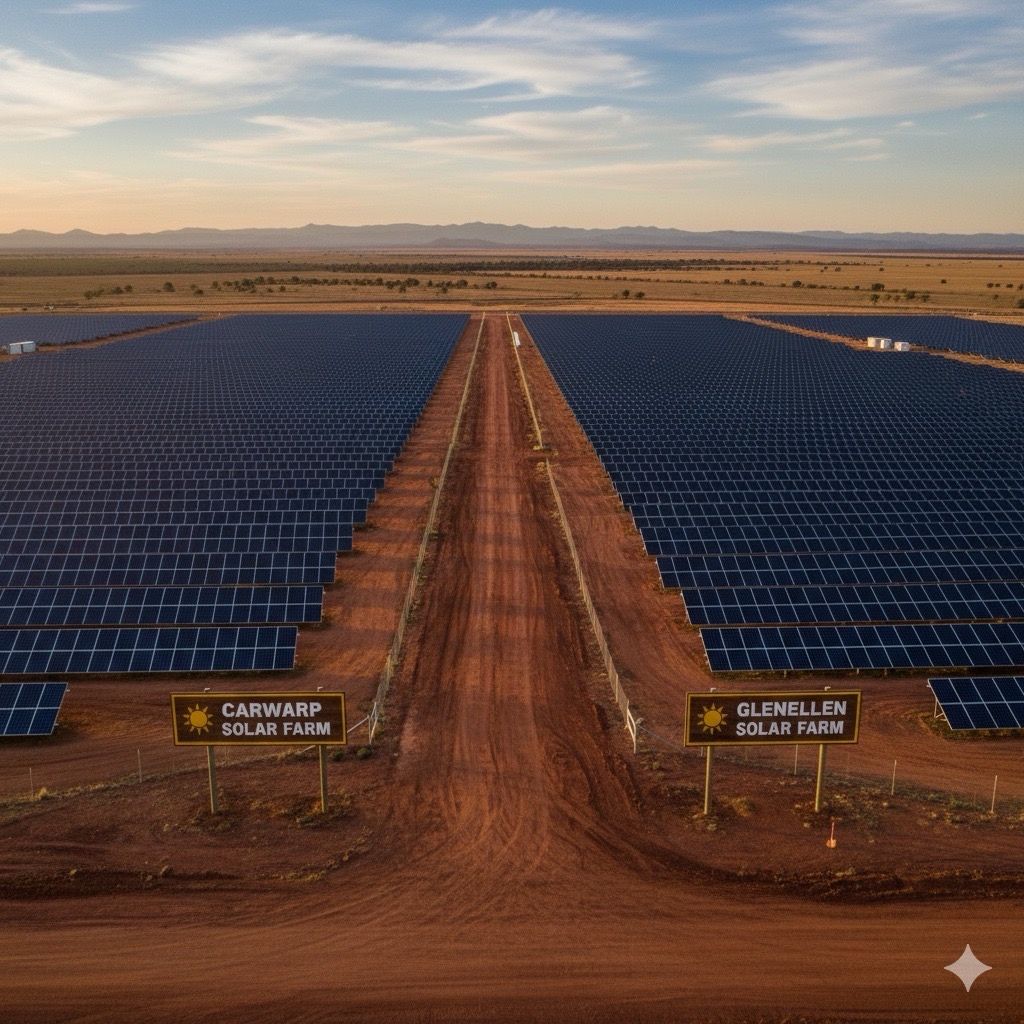
AEMO grid connection and registration for two utility-scale solar farms - connection studies through negotiation, registration and R2 commissioning.
The story →The GFM BESS paper
Paper 11251 - compliance and model validation of a grid-forming battery replacing synchronous generation on Australia's northern grid.
The paper →Frequently asked questions
What is the difference between a generator performance study and a grid connection study?
In practice, very little - they are two names for one package of work. Generator performance studies prove the plant's behaviour against the GPS clauses of NER Schedule 5.2; grid connection studies add the network-facing assessments - fault level impact, protection coordination, earthing - the network service provider needs before it will connect the plant. The same models and the same engineers carry both.
Which studies prove which GPS clauses?
Load flow evidences reactive capability (S5.2.5.1) and network impact (S5.2.5.12); dynamic and transient stability studies prove the ride-through clauses (S5.2.5.3–5) and the control clauses (S5.2.5.11, 13, 14); harmonics and power quality studies prove S5.2.5.2; fault level and protection studies evidence S5.2.5.8–10; and EMT studies carry the inverter clauses wherever system strength is low.
Who needs generator performance and grid connection studies?
Any plant whose connection could affect the network: registered generators of every technology, grid-scale batteries and hybrid plants - assessed charging and discharging - and increasingly large industrial loads and data centres, which face connection studies and performance requirements of their own even though they never export a megawatt. The trigger is network impact, not technology.
Are generator performance and grid connection studies required in Western Australia?
Yes. The South West Interconnected System sits outside the NEM, but the WEM Rules carry an equivalent Generator Performance Standards framework, administered by AEMO with Western Power as the network operator - and the Pilbara's NWIS runs its own technical rules under Horizon Power. The study engineering is the same; the clause references, data formats and gates are not.
What software are grid connection studies run in?
The tools the reviewers themselves use: PSS®E and DIgSILENT PowerFactory for the steady-state and RMS dynamic work, and PSCAD for EMT studies of the full waveform. Every dynamic model must pass AEMO's model acceptance testing before the studies it feeds are accepted - which makes model quality, not simulation hours, the real schedule risk.
Go deeper: the two sides of this page
This page is the combined map; each side has its own full guide. The grid connection process guide walks every study - load flow to earthing, R0 to R2 - one at a time, with where each goes wrong. The generator performance standards guide walks the standard itself - the S5.2.5 clause families, the automatic-negotiated-minimum spectrum, the 5.3.4A negotiation and compliance for life. Behind both sits the power system studies practice and the grid connection service that delivers them as one package.