Home · Insights · Substation design standards

Substation design standards in Australia: every layer, every network, in one reference.

Search for substation design standards and you will find the PDFs themselves - Transgrid's, Western Power's, Powerlink's, each excellent and each silent about the others. What nobody publishes is the map. This is it: the national and international spine, every network owner's published suite, and what actually changes between them - from the team accredited to design to most of them.

November 2026 · Insights

By Jordan Kosek - Managing Director, APD Global · seventeen years with the firm behind 15,000+ power projects and substation design up to 500 kV

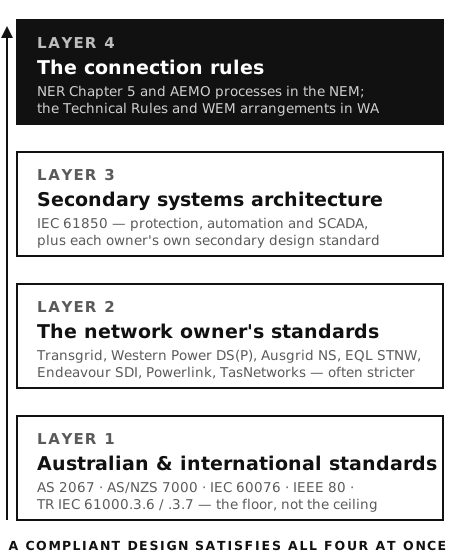
Substation design in Australia is governed by four layers of standards at once: AS 2067 and the national and international spine at the base; the design standards each network owner publishes, which are frequently stricter; IEC 61850 and the owner's secondary standards for protection and automation; and the connection rules - the National Electricity Rules in the NEM, the Technical Rules and WEM arrangements in Western Australia. A design that satisfies all four layers is the deliverable. A design that satisfies three of them is a review cycle.

1. Why a map, not another PDF

No single document tells a designer what an Australian substation must comply with. The Australian Standard sets the floor. The network owner's standards sit on top of it and win every conflict. The secondary architecture has its own language, and the connection that justifies the yard runs under a rulebook that varies by market. Each layer is published somewhere - this page puts them in one place, with the authoritative source for each, and is kept current as the documents move. Because they move: these are living suites, and owning the PDF is not knowing the standard.

One correction worth making before the list, because it is repeated all over the industry: the 2012 power quality documents are TR IEC 61000.3.6:2012 and TR IEC 61000.3.7:2012 - technical report adoptions. There is no "AS/NZS 61000.3.6:2012"; the AS/NZS designations stopped at the superseded 2001 editions. Citations matter in documents that get reviewed by network owners.

The four layers of standards governing substation design in Australia - Australian and international standards at the base, the network owner's design standards, the IEC 61850 secondary architecture, and the connection rules on top

The four-layer stack - every Australian substation design answers to all of it

2. The national and international spine

Eight documents do most of the work beneath every network owner's suite. What each covers, and when it applies:

AS 2067:2016 Substations and high voltage installations exceeding 1 kV a.c. - the spine of Australian substation design. Minimum requirements for design and erection: electrical clearances and safety distances, equipment selection, fire and arc-fault protection, risk-based earthing, inspection and testing. Every yard is measured against it; treat it as the floor, not the ceiling. Standards Australia →
AS/NZS 7000:2016 Overhead line design - structural, electrical and geotechnical design of overhead lines from distribution to EHV. It governs the line side of every substation terminal, and it is the base standard the Transgrid, TasNetworks and Ausgrid line standards are built on. Standards Australia →
AS/NZS 3000:2018 Wiring Rules - the boundary standard. Everything below 1 kV inside the substation - LV auxiliary systems, building services, the interface to customer installations - falls to it where AS 2067 leaves off. Standards Australia →
TR IEC 61000.3.6:2012 Harmonic emission limits, MV/HV/EHV - the methodology network service providers use to allocate harmonic emission limits at connection points, and the basis of the power quality allocation argued in every connection study. Supersedes AS/NZS 61000.3.6:2001. Standards Australia →
TR IEC 61000.3.7:2012 Voltage fluctuation and flicker, MV/HV/EHV - the companion allocation methodology for fluctuating installations. Supersedes AS/NZS 61000.3.7:2001. Standards Australia →
IEC 61850 Communication networks and systems for power utility automation - the architecture language of the modern secondary system: station and process bus, GOOSE and sampled values, IED data models. Referenced by every current Australian secondary design standard, and the layer where a substation earns its reliability. IEC →
IEC 60076 Power transformers - the series behind every transformer specification in the yard, anchored by Part 1 (ratings, connection symbols, specification and testing). The largest, longest-lead and most transport-constrained item of plant in the substation is specified to it. IEC →
IEEE 80-2013 Guide for Safety in AC Substation Grounding - the earth-grid design methodology: step and touch voltage limits, grid current, soil modelling. IEEE SA has listed it as Inactive-Reserved since March 2024, but it remains the cited edition and the industry-standard guide, applied in Australia alongside AS 2067's risk-based earthing requirements and the ENA's EG-0 and EG-1. IEEE SA →
4layers of standards on every Australian substation design
500 kVsubstation design delivered in-house
7+network owners APD is accredited with across Australia and NZ
1stAustralian world winner · Bentley YII 2026 · Transmission & Distribution
27years · established 1999

3. The utility layer: what each network owner publishes

This is the layer that decides projects, and it is published unevenly - some owners maintain open libraries, others publish nothing and issue requirements per project. Network by network:

New South Wales and the ACT

Transgrid

Substation Primary Design Standard · Secondary Systems Design Standard · Transmission Line Design Standard

Published under NER clause 5.2A.5, and the cleanest public statement of transmission substation requirements in the NEM: the primary plant, layout and ratings of its yards (Rev 2, November 2021), protection and control to 500 kV (Rev 2.1, November 2023), and a line standard built on AS/NZS 7000.

Ausgrid

NS210 - Major Substations: Design and Construction · NS-series Network Standards

NS210 leads the substation suite, and the companions show how far an owner's standards reach past the electrical design: NS185 through NS200 cover the buildings, civil works, fire systems, overpressure, oil containment and ventilation, NS116 the earthing, NS220 the overhead design. On an Ausgrid site, the building is substation compliance too.

Endeavour Energy

SDI505 - Transmission and zone substations · EDI516 earthing · ADI0012 automation

Publishes its suite through a public standards index - SDI505 sets the minimum design and construction requirements for transmission and zone substations, EDI516 the major substation earthing, ADI0012 the substation automation.

Essential Energy

Accredited-designer framework · connection manuals

Runs design acceptance through its accredited-designer framework and connection manuals rather than a public substation design suite - one of several networks where the working detail arrives with accreditation, not with a search engine.

Queensland

Powerlink Queensland

Substations - High Level Design Criteria (March 2025) · SDE-001

Publishes its connection suite under NER Schedule 5.10, including the Substations - High Level Design Criteria guideline (March 2025), which sets out what its substations must achieve and points to the internal SDE-001 electrical design standard behind it.

Energex & Ergon Energy

STNW3003 - Standard for Substation Design Requirements · joint Energy Queensland suite

Design to a joint Energy Queensland suite, published through the open EQL technical documents library. STNW3003 - successor to Energex's RED364 - anchors it, and its reference list is a map of its own: STNW3014 for busbars, STNW3028 for earthing (naming ENA EG-0, EG-1 and IEEE 80), STNW3032 for lightning shielding, STNW3035 for fire, STNW3036 for oil containment.

Victoria

No published substation design suite - by design

Worth saying plainly: no Victorian distributor publishes a substation design suite equivalent to Ausgrid's NS series, EQL's STNW set or Western Power's DS(P) standards. The Victorian networks publish embedded-generation access standards and work under the Victorian Service & Installation Rules, with substation design requirements delivered per project - so Victorian designs lean harder on the national spine and the owner's project-specific requirements. What each network does publish, and where it lives:

CitiPower & Powercor

Embedded-generation access standards · per-project substation requirements

Publish their renewable-generation connection pathway and embedded-generation access standards through the shared Powercor portal. Generation above roughly 10 MW generally connects at 66 kV sub-transmission, and every Victorian generator above 200 kVA carries the state's remote-curtailment backstop.

United Energy

UE ST 2008-1 · 2008-2 · 2008-3 network access standards

Same operator group as CitiPower and Powercor, but with its own portal and its own UE ST 2008 access-standard series covering LV and HV embedded generation on its network.

Jemena

Connection Principles & Guidelines (>5 MW) · ELE SP 0003 access standards

Publishes connection principles and guidelines for large embedded generation above 5 MW, backed by the ELE SP 0003 access standards - and since October 2023, a backstop guideline applies to every application above 200 kVA.

AusNet

SOP 33-05 embedded-generation guidelines · functional specifications per transmission connection

Distribution publishes its guidelines for connecting embedded generators of 5 MW and above (SOP 33-05). The transmission business issues functional specifications per connection rather than a public design library.

Current - but changing: VicGrid

The part to watch. Victoria's shared-network transmission connection process has historically been run by AEMO in its role as the state's transmission planner - unique in the NEM - and that process is now transitioning to VicGrid, the state body taking over management of Victorian connections end to end, with AusNet providing the physical connection. Anyone connecting at transmission level in Victoria should read AusNet's transmission connection pages and AEMO's Victorian process side by side, and expect the names on the gates to keep changing while the handover completes.

South Australia

SA Power Networks

Technical Installation Rules - TS132 · TS133 · TS134 · NICC270

Publishes enforceable Technical Installation Rules through its technical standards pages - TS132 and TS133 for LV and HV embedded generation, TS134 for SCADA and communications, with the NICC270 connection standard setting the process around them.

ElectraNet

Per-project functional specifications

ElectraNet, like AusNet's transmission arm, issues substation design requirements per project through functional specifications rather than a published suite.

Tasmania

TasNetworks

R-numbered transmission standards library - roughly thirty-five standards

The best public transmission standards library in the NEM - covering substation civil design and construction (R590634), lightning protection and earthing (R522692, revised June 2025), general equipment detail and layout (R1089602), the transmission line design standard (R1037048, with AS/NZS 7000 normative) and the protection and SCADA suites. For anyone who wants to see how a complete owner's layer fits together, start there.

Western Australia

Western Power

DS(P) substation design standard suite · Distribution Substation Plant Manual · Technical Rules

The DS(P) suite covers earthing (pairing AS 2067 with ENA EG-0), layout, busbars, clearances, AC and DC auxiliary supplies, lightning, oil containment and fire, buildings, fences and secondary systems - with a Distribution Substation Plant Manual on the distribution side. Note one recent change: the standard-design drawings have been removed from public view, so the published design standards and your Western Power contact are the working references. Above the suite sits the Technical Rules - because the SWIS runs under the WEM framework, not the NER.

Horizon Power

Horizon Power Technical Rules - HPC-9DJ-01-0001-2012

Governs the North West Interconnected System and its regional networks through the Horizon Power Technical Rules - the substantive public technical document for those systems, with project-level requirements agreed directly.

Northern Territory

Power and Water Corporation

Network Technical Code · Network Planning Criteria

Works under its Network Technical Code and Network Planning Criteria - the January 2023 edition is published through the AER - supported by a set of power network design and construction guidelines on its own site. The NT applies its own adoption of the NER, and the code is where its substation performance requirements live.

4. Designing to Transgrid vs Western Power: what actually changes

Here is the part no standards library can publish. The physics of a substation never changes between networks - AS 2067's clearances protect the same human body in Sydney and in Perth. What changes is the compliance evidence, and it changes more than people expect.

Earthing is the sharpest example. Western Power's earthing standard pairs AS 2067 with the ENA's risk-based EG-0 methodology; EQL's STNW3028 names EG-0, EG-1 and IEEE 80 together; other owners weight the deterministic IEEE 80 approach more heavily. Same soil, same fault current, same safety outcome - but the acceptable argument, the study deliverables and the review questions differ, and an earthing report written in the wrong network's dialect reads as wrong even when the grid is right. Earthing design and testing →

The tables and the plant differ. Each owner's clearance tables sit at or above AS 2067, and they are not identical to each other. Preferred busbar arrangements, standard bay dimensions, approved plant lists, labelling and drafting conventions - all owner-specific, all enforced at review. The same 132 kV zone substation is a genuinely different drawing set for Essential Energy than for Western Power, which is why APD delivered South Jerrabomberra to the former and Bunning Lake to the latter as different designs, not one design re-badged.

The secondary philosophy differs most. Transgrid publishes a dedicated secondary systems standard to 500 kV; TasNetworks maintains its own IEC 61850 standard inside that R-numbered library; Ausgrid's NS series makes buildings, fire and ventilation part of substation compliance. Designing across them means holding several owners' protection and automation philosophies at once - which is why APD built its own IEC 61850 process bus testing environment rather than learning on a client's asset, and published the method at CIGRE Paris 2026. The paper →

And the gates differ. Most owners require formal designer accreditation before work is accepted, and each runs its own review cadence. APD Global is accredited with Essential Energy, Western Power, Transgrid, ElectraNet, Ausgrid, AusNet and TasNetworks among others - and the practical value of accreditation is not the certificate, it is the current working knowledge of how each owner's reviewers read each owner's documents. A designer who last delivered to a utility three years ago is designing to a version of that utility that no longer exists.

South Jerrabomberra 132 kV GIS zone substation - designed to Essential Energy's requirements by APD Global

South Jerrabomberra - 132 kV GIS to Essential Energy's requirements. The project →

Bunning Lake GIS substation - designed to Western Power's DS(P) design standards by APD Global, from a digital twin

Bunning Lake - GIS to Western Power's standards, designed from a digital twin. The project →

Clean Energy Link – North 330 kV terminal substation design - Bentley YII 2026 world award winner for Transmission and Distribution

Clean Energy Link – North - 330 kV terminals in WA, Bentley YII 2026 world award winner. The win →

The standards, applied

330 kV brownfield · NSW

Eraring BESS

A new BESS substation tied into a live 330 kV switchyard - where the owner's standards, AS 2067 and the staging all have to hold at once.

The project →

CIGRE Paris 2026 · B3

Brownfield by generative design

Paper 10389 - AI-driven generation and optimisation of substation designs in brownfield context, the method now applied on APD brownfield jobs.

The paper →

Design at scale · NT

56 power stations, one code

SLDs and network models for 56 remote community power stations for Power and Water - the Network Technical Code applied across an entire territory.

The EPC work →

5. The connection layer, briefly

The fourth layer is the rulebook that justifies the substation existing at all. In the NEM, connections run under Chapter 5 of the National Electricity Rules through AEMO's processes, and the transmission owners publish their design standards under the NER's transparency clauses. In Western Australia the framework is the Electricity Networks Access Code, the WEM Rules and the Technical Rules - not the NER - and the distinction shapes everything from study scope to approval gates. That layer has its own reference: the grid connection process in Australia, every study explained.

Frequently asked questions

What standards govern substation design in Australia?

Four layers at once. AS 2067 - the Australian standard for substations and high-voltage installations exceeding 1 kV - sets the base, alongside AS/NZS 7000 for overhead lines, the IEC 60076 series for transformers and IEEE 80 for earthing. Each network owner then applies its own published design standards, which are frequently stricter. Secondary systems are designed to IEC 61850. And the connection itself runs under the National Electricity Rules in the NEM or the Technical Rules and WEM arrangements in Western Australia. A compliant design satisfies all four layers at once.

What is AS 2067?

AS 2067:2016 - Substations and high voltage installations exceeding 1 kV a.c. - is the spine of Australian substation design. It sets the minimum requirements for the design and erection of high-voltage installations: electrical clearances and safety distances, equipment selection, protection against fire and arc faults, risk-based earthing, and inspection and testing. Every Australian switchyard is measured against it, and most network owners' own standards build on it with stricter tables of their own.

Do all Australian network owners publish substation design standards?

No - and the asymmetry catches people. Transgrid, Western Power, Powerlink, TasNetworks, Ausgrid, Endeavour Energy and Energy Queensland all publish substantial substation design standards or libraries. The Victorian distributors publish embedded-generation access standards and the Victorian Service & Installation Rules instead of a public substation design suite, and ElectraNet and AusNet's transmission business issue design requirements per project through functional specifications rather than a published library.

Is IEEE 80 still the standard for substation earthing?

IEEE 80-2013 remains the industry-standard guide for AC substation earthing - the step and touch voltage limits, grid current and soil modelling methodology cited across Australian practice - although IEEE SA has listed it as Inactive-Reserved since March 2024. In Australia it is applied alongside AS 2067's risk-based earthing requirements and the ENA's EG-0 and EG-1 guides, and several network owners name all three in their own earthing standards.

What actually changes when designing to different network owners' standards?

The physics never changes - the compliance evidence does. Clearance and layout tables differ from AS 2067's baseline and from each other; earthing standards weight risk-based ENA EG-0 methods and deterministic IEEE 80 methods differently; preferred plant, busbar arrangements, drafting conventions and review gates are all owner-specific; and most owners require formal designer accreditation before work is accepted. A technically sound design to the wrong network standard is a rejected design.

Talk to the team that designs to them

APD Global delivers substation design and engineering up to 500 kV - accredited with the major Australian network owners and designing to their current standards, not a three-year-old memory of them. For how those standards play out on a real project, start with the guide to substation design in Australia.

Standards and network-owner documents linked above are the publishers' own authoritative sources, current at November 2026. Standards move - always confirm the current edition with the publisher or the network owner before relying on it.